2026 General Assembly
The 2026 Virginia General Assembly session is a critical opportunity to advance policies that protect our environment, strengthen community health, and build climate resilience across the Southside. This page includes the legislation we’re watching, ways you can take action to support key bills, and resources to help you engage effectively throughout the session. Together, these efforts can help ensure community voices are heard in the policymaking process. Explore the sections below to learn how you can be part of a successful legislative session.
Our advocacy is powered by the people who live, work, and play in Southside Richmond. Never miss an update by signing up for our Policy Alert emails.
Keys Bills We’re Watching
Below are the bills we are most closely watching during the 2026 General Assembly session. Organized by issue area, these proposals align with our policy agenda and would move the Southside closer to environmental justice if passed. Click the + icon next to each bill to learn more about what it does and why it matters. Available opportunities for public action are noted for each bill.
Data Center Bills
-
Patron: Delegate Amy Laufer
Status: Continued (action on the bill has been postponed until next year's regular session)
This bill directs the Virginia Department of Environmental Quality to conduct a three-year study on air pollution in areas with high concentrations of data centers. The study will examine the combined air quality impacts of diesel backup generators and model different growth scenarios. DEQ will also evaluate whether current “minor source” air permits remain adequate and if additional air monitoring is needed. Findings and recommendations must be reported to state lawmakers by October 1, 2029.
-
Patron: Delegate Elizabeth Guzman
Status: Signed into Law
This bill requires data center developers to disclose how much water their facilities are expected to use before local governments approve new projects. Applicants must provide clear water use estimates — including average, maximum daily, and total annual use — whether the project requires rezoning or is built by right. The bill prevents developers from hiding water consumption data behind nondisclosure or confidentiality agreements. It also preserves local zoning authority, ensuring communities retain control over land-use decisions.
-
Patron: Delegate Danica Roem
Status: Signed into Law
This bill limits new data centers to land that is already zoned or used for industrial purposes. Local governments would only be allowed to approve data center projects on industrially zoned parcels for applications submitted after July 1, 2026. The goal is to prevent incompatible siting in residential, rural, or environmentally sensitive areas while maintaining local land-use authority.
Environmental Justice & Community Health Bills
-
Patron: Delegate Kathy Tran
Status: Signed into Law
This bill strengthens environmental justice protections by requiring greater community input and review before DEQ can issue permits for certain high-impact projects. Applicants must create a public participation plan, hold public hearings, provide multilingual notice, and respond to community concerns. The bill requires DEQ to evaluate cumulative pollution impacts on environmental justice communities and to require mitigation when harms are identified. If an applicant fails to meet these requirements or address disproportionate impacts, DEQ must deny the permit.
-
Patrons: Delegate Shelly Simonds (HB) and Senator Lamont Bagby (SB)
Status: Signed into Law
These bills require larger cities and counties to consider adopting an environmental justice strategy as part of their comprehensive planning process. The strategy would identify environmental justice and fenceline communities within the locality. Local governments would then set goals to reduce health risks, increase civic engagement, and prioritize investments that address long-standing environmental harms. The bill helps ensure community planning decisions account for equity, health, and environmental impacts.
-
Patrons: Delegate Rae Cousins and Senator Jennifer Boysko
Status: Defeated (the bill failed to pass and is "dead" for the remainder of the current legislative session)
These bills create the Extreme Weather Taxpayer Protection Program to hold major fossil fuel companies financially responsible for their role in climate change. Companies that produced at least one billion metric tons of greenhouse gas emissions between 1995 and 2025 would be required to help cover Virginia’s climate-related costs. The funding would be deposited into a new Extreme Weather Relief Fund to support disaster recovery and resilience projects. The goal is to reduce the financial burden on taxpayers as extreme weather events become more frequent and costly.
-
Patron: Delegate Jackie Glass
Status: Continued (action on the bill has been postponed until next year's regular session)
This joint resolution directs JLARC to study how local governments and other non-federal partners currently share the costs of managed retreat studies for properties threatened by sea level rise. The study will evaluate whether the existing funding approach is fair and effective for legacy property owners. It also examines whether a dedicated state fund should be created to help cover local cost-share requirements. The goal is to reduce financial barriers for communities facing increasing flood and sea level rise risks.
-
Patron: Delegate Shelly Simonds
Status: Signed into Law
This bill encourages localities to use available data and research on social determinants of health when developing or updating their comprehensive plans. It directs communities to consider how land use, transportation, housing, and infrastructure decisions affect overall public health and access to health care services. By integrating health data into long-term planning, the bill promotes more informed, equitable decision-making that can reduce health disparities. The goal is to ensure that local planning supports healthier communities and improved health outcomes for residents.
Energy Bills
-
Patron: Delegate Mark Sickles
Status: Signed into Law
This bill aims to lower energy costs for low-income households by expanding access to home energy efficiency upgrades. It requires Virginia’s major electric utilities to make reasonable efforts to provide heating-related efficiency improvements to at least 30 percent of qualifying households by 2031, if approved by the State Corporation Commission. These upgrades could include measures that reduce energy use and improve home comfort. Utilities must regularly report their progress and plans to the Commission.
-
Patron: Delegate Destiny LeVere Bolling
Status: Signed into Law
This bill creates a statewide task force to identify barriers that prevent low-income households from accessing energy efficiency and weatherization programs. Led by the Department of Housing and Community Development in coordination with state agencies, the group will evaluate gaps in enrollment, funding, and agency coordination. The task force will develop policy recommendations to improve delivery of energy efficiency upgrades, including weatherization-ready repairs and whole-home retrofits. Its goal is to ensure all eligible households — including those in multifamily, single-family, and manufactured homes — can access these resources by 2034.
Urban Forestry Bills
-
Patron: Delegate Patrick Hope
Status: Signed into Law
The bill expands authority for tree replacement requirements during development statewide, allowing qualifying localities to adopt minimum canopy coverage standards measured at tree maturity as part of site plan approval. Currently, this authority is limited to Arlington. HB549 also incorporates language from HB995, consolidating those provisions into a single bill.
-
Patron: Delegate Holly Seibold
Status: Defeated (the bill failed to pass and is "dead" for the remainder of the current legislative session)
This bill requires public utilities to coordinate with local governments before trimming trees or vegetation in public parks. Utilities must limit pruning to what is necessary to maintain safe and reliable electric service. The bill helps protect tree canopy and park landscapes while still allowing essential utility maintenance. It promotes better communication and balance between infrastructure reliability and community greenspace preservation.
-
Patron: Senator Angelia Graves
Status: Signed into Law
This bill adds oversight of the Forest Sustainability Fund to the responsibilities of the Office of Working Lands Preservation within the Department of Forestry. The change helps better align forest conservation, sustainable management, and working lands protection efforts. By centralizing fund management, the bill improves coordination and long-term planning for Virginia’s forest resources. Stronger forest stewardship supports rural economies, climate resilience, and wildlife habitat.
Water & Infrastructure Bills
-
Patron: Delegate Rae Cousins
Status: Continued (action on the bill has been postponed until next year's regular session)
This bill allows local governments statewide to charge impact fees on certain residential developments to help pay for the public infrastructure those projects require. Currently, only a limited number of counties are authorized to use impact fees, restricting communities’ ability to keep up with growth. The bill expands local authority and removes regional limitations on what types of public facilities may be funded. This helps ensure that new development contributes its fair share to schools, transportation, utilities, and other essential community services.
-
Patron: Delegate Alfonso Lopez
Status: Signed into Law
This bill strengthens Virginia’s conservation planning by improving how wetlands are identified and protected under the ConserveVirginia program. It requires the Department of Conservation and Recreation to map lands adjacent to existing wetlands and areas suitable for future wetland migration. This data will help guide conservation investments in flood-prone and climate-vulnerable areas. Protecting space for wetlands to move inland improves flood resilience, water quality, and ecosystem health as sea levels rise.
Invasive Plant Management Bills
-
Patron: Delegate Amy Laufer
Status: Signed into Law
This bill requires the Commonwealth Transportation Board to create and implement a policy to identify and remove invasive plant species along state highway rights-of-way. It also prohibits the planting of any invasive plants listed by the Department of Conservation and Recreation on state highways. Current law only restricts a small number of species under limited conditions. The bill strengthens statewide efforts to prevent the spread of invasive plants that harm ecosystems and increase long-term maintenance costs.
-
Patron: Delegate Holly Seibold
Status: Signed into Law
This bill updates Virginia’s definition of “noxious weeds” by removing exemptions for plants that are commercially grown or sold in the state. It also eliminates requirements to consider commercial viability or economic impacts when determining whether a plant should be classified as noxious. The change allows state officials to prioritize environmental harm over market interests. This strengthens Virginia’s ability to prevent the spread of invasive species that threaten agriculture, forests, and native ecosystems.
-
Patrons: Delegate Katrina Callsen and Senator Saddam Azlan Salim
Status: Signed into Law
This bill authorizes local service districts to control invasive plant species within their boundaries. By expanding local authority, the bill allows communities to respond more quickly to ecological threats. Managing invasive plants helps protect native habitats, water quality, and public lands. The bill provides an additional tool for local governments to support environmental restoration efforts.
How to Submit Public Comment for a House Bill
When a bill is assigned to a committee or subcommittee, the chair will ask for public comment after the patron presents it. Residents can testify in person or opt to submit a comment online. To submit a comment online:
Open the SPEAK web application for submitting public comment to the House of Delegates.
Find the bill you want to comment on in the list and check the box. If you can’t find the bill number, make sure you are looking at bills in the right committee. The LIS page for the bill will tell you what committee it was referred to if you aren’t sure.
Click "next" at the bottom of the screen.
Fill out all the required information on the form.
Hit "submit" to send your public comment to the committee.
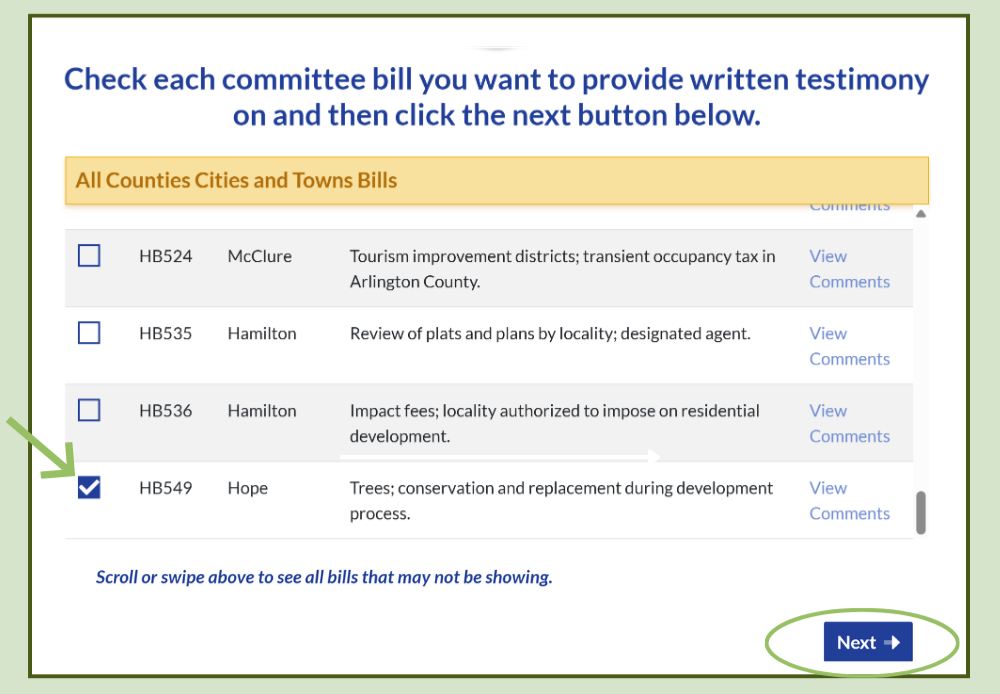
This screenshot shows the SPEAK web application for the House of Delegates. You can scroll through the bills to find what you are looking for, or if you know the bill number, you can use a keyboard shortcut to search for it.
In our blog, co-founder Sheri Shannon explains what’s coming in the 2026 General Assembly, how Virginians can get involved, and why our collective advocacy matters.
Key Session Dates
January 12: Virginia General Assembly swearing-in ceremony
January 14: Prefiling deadline for legislators, the final cutoff date for legislators to submit bills and resolutions for consideration before the session officially begins
January 15: First day of General Assembly Session
January 17: Abigail Spanberger’s swearing-in ceremony as Virginia’s 75th governor
February 18: Crossover deadline for bills and resolutions
February 22: “Budget Sunday,” when the House Appropriations and Senate Finance committees present their budget recommendations, including spending priorities and revenue proposals
March 14: Expected adjournment Sine Die