
Part II: The Geography of Belonging: Will Code Refresh Cause Displacement?
By Annika Schunn, guest blogger, Policy Advocate at Housing Opportunities Made Equal of Virginia
Series Introduction
The places we call home are shaped by policies and investments we choose to prioritize. Richmond's zoning code shapes where people can live, how neighborhoods grow over time, and who has access to opportunity. Yet the city's zoning ordinance has remained largely unchanged for more than 50 years, reflecting broader planning and infrastructure systems that have also struggled to keep pace with the city's changing population, economy, and housing needs.
As the city continues to work on the next draft of Code Refresh, Southside ReLeaf is asking our neighbors a fundamental question: “What kind of community are we trying to build?”
To help explore this question, we invited partners who advocate for housing affordability to guest-author a three-part series examining the relationship between housing and zoning in Richmond.
In Part II of the series, Annika Schunn explores what decades of research tell us about the relationship between new housing, displacement, and affordability. The blog also examines why zoning reform alone isn't enough, and why preventing displacement requires a broader commitment to policies that help longtime residents stay rooted in their communities.
As recently as the year 2000, Richmond was a majority-Black city. In the years since, Richmond has seen significant change and reinvestment while adding nearly 43,000 residents. Today, Richmond is no longer majority-Black.
Vibrant cities change. In places with opportunity, demographics shift, businesses come and go. But in the 21st century, Richmond’s changes have accompanied — and helped to spur — displacement of Black and low-income residents.
Now, some of those who remain are wondering whether Code Refresh, the City’s zoning overhaul, will make it worse.
How Displacement Happens in Richmond
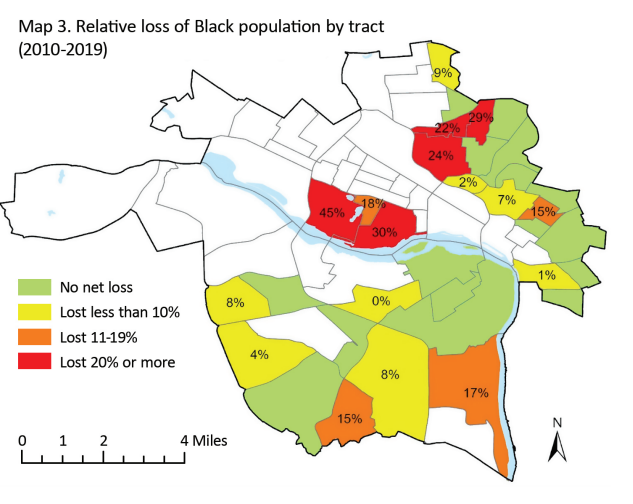
This map shows the relative loss of the Black population in Richmond by census tract between 2010 and 2019. One area, covering Maymont, Byrd Park, and Carillon, lost 45% of its Black population.
Displacement is an involuntary move. Sometimes it’s caused by a disaster, such as a hurricane. More often, it comes from policy decisions, like the urban renewal and highway projects that destroyed Jackson Ward, Randolph, and Fulton. Displacement can look like a renter leaving after a rent hike, or a homeowner selling because they can’t keep up with repairs or property taxes. Rising costs force low-income people out while keeping others from moving in — and those who can’t afford to stay often end up in worse housing or homeless.
A 2024 study by Housing Opportunities Made Equal of Virginia (HOME of VA) found significant displacement in Richmond’s majority-Black neighborhoods between 2010 and 2019. One area, covering Maymont, Byrd Park, and Carillon, lost 45% of its Black population. Parts of the Northside lost 22-29%, and Southside neighborhoods lost as much as 17%.
The report identified racially biased home valuation as a root cause of this dramatic demographic shift. Along with redlining, urban renewal, and exclusionary zoning, appraisal bias worked to starve Black neighborhoods of investment while protecting white ones. Then the city drew affluent white residents back and, in 2005, reversed a decades-long trend of population decline. But as the city grew, homebuilding did not keep pace, and rising demand for limited homes in city neighborhoods rapidly drove up property values. Residents in disinvested neighborhoods held on as long as they could — until rising costs forced them out.
This is a national pattern. When property values rise, families in disinvested, segregated areas struggle because they were denied the ability to build wealth over time. And when housing is scarce, values often rise fastest in formerly redlined neighborhoods.
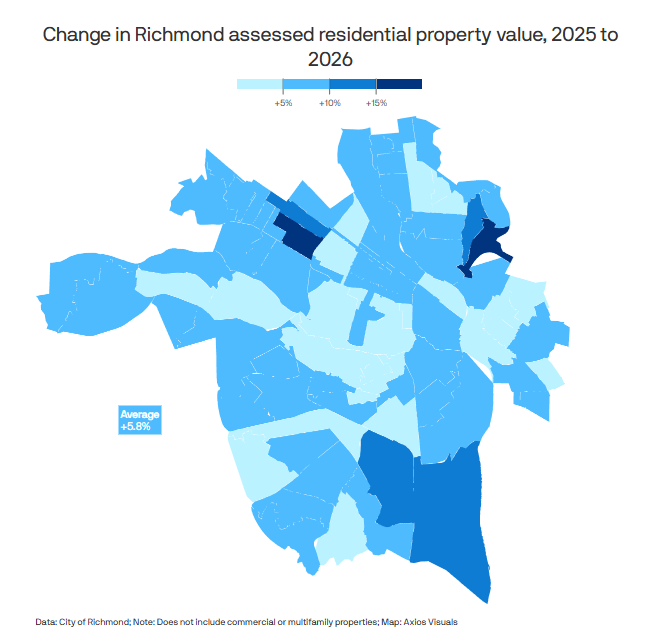
This map, created by Axios Visuals, illustrates the change in assessed residential property values in Richmond from 2025 to 2026. Some of the areas that saw the greatest increases in value are located in formerly redlined areas.
Today, pressure on limited housing supply continues to drive up costs every year, and low-income residents find it harder and harder to stay.
No wonder residents are skeptical of proposals that could affect their neighborhoods. Many have already witnessed irreversible change in their communities. Now, as Richmond rewrites its zoning for the first time in 50 years, many are rightfully asking: will this help our most vulnerable residents, or hurt them?
That deserves an honest answer.
What is Zoning’s Role in Displacement?
Richmond, like many cities, is confronting a profound housing crisis. Since 2018, the city has had one of the highest eviction rates in the country. Rising costs are making it harder for residents to stay in the city long-term, with the greatest burden on Black residents and renters.
Almost half of Richmond residents can’t imagine staying long-term because of rising costs. Among Black respondents, it’s 52%. Among renters, 67%.
Nearly a third of residents and over half of renters pay more for housing than they can afford.
The number of residents receiving help with homelessness climbed from 4,774 in 2010 to 8,939 in 2025 — an increase of over 87%.
One root cause of rising housing costs? We don’t have enough housing.
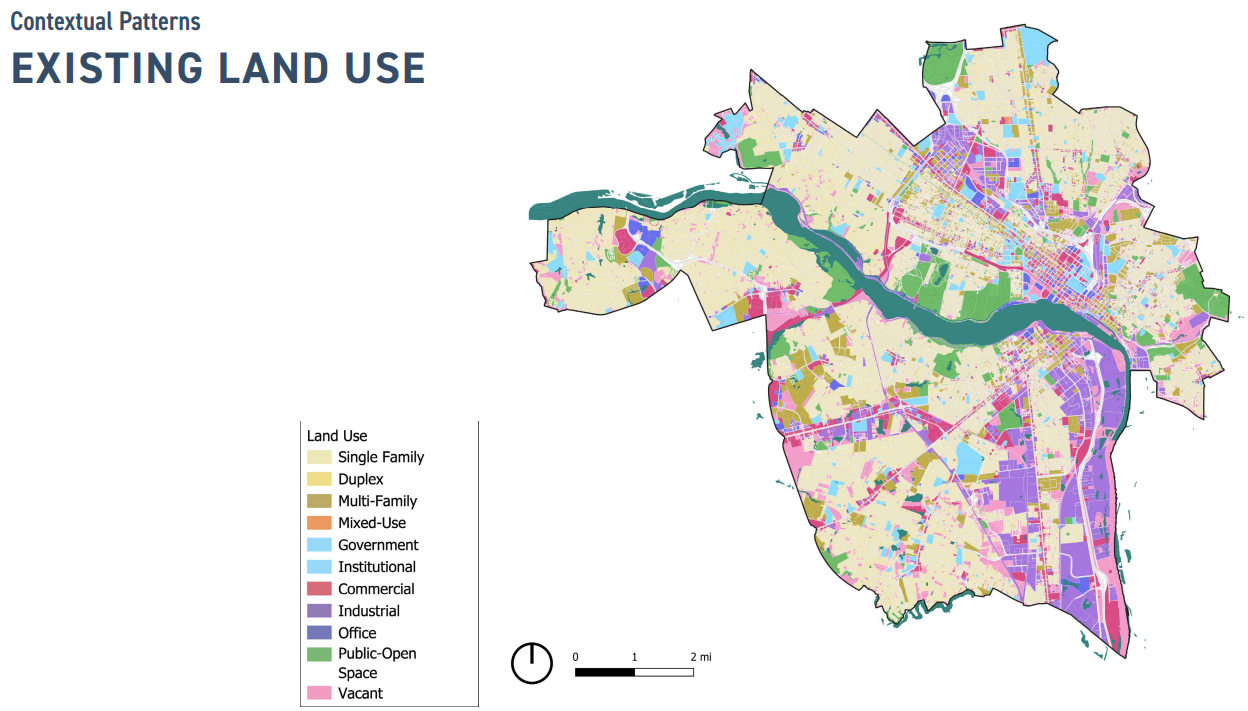
This illustration shows the existing land-use patterns in Richmond that are permitted under the current zoning code. Most land is reserved for single-family housing, while land designated for more affordable housing types, like duplexes and multi-family housing, is much more limited.
In 2023, the Partnership for Housing Affordability estimated Richmond was short 18,000 affordable rental homes — the result of decades of underbuilding colliding with rapid population growth.
Strict land-use rules are one obstacle. In Richmond, as in many cities, most land has been reserved for the most expensive kind of housing: single-family homes. Other kinds of homes, which cost less to build, buy, rent, and serve with public infrastructure, have largely been shut out. Allowing more housing types in more places could create homes that more people can afford.
Does New Housing Push People Out?
Skeptics worry that because new housing is often more expensive than older housing, building it will gentrify neighborhoods and displace the people already there. Gentrification is often conflated with displacement, but it describes something specific: a change in who lives in a neighborhood, most often higher-income, college-educated, and/or white residents moving into an area that was previously lower-income or majority-minority. As they arrive, the thinking goes, existing residents get priced out. Nothing symbolizes that shift more than new construction.
But decades of housing research tells a different story.
Most evidence shows that increasing housing supply is helpful rather than harmful to existing residents. Even expensive new construction is likely to make other housing more affordable and to make neighborhoods more accessible to lower-income residents.
Studies consistently find that new housing slows how quickly costs rise, especially across a city or region. Last year, Pew analyzed data from 1,654 ZIP codes and found that new housing slowed rent increases most in lower-income neighborhoods. In short, new construction makes housing more affordable overall, not less.
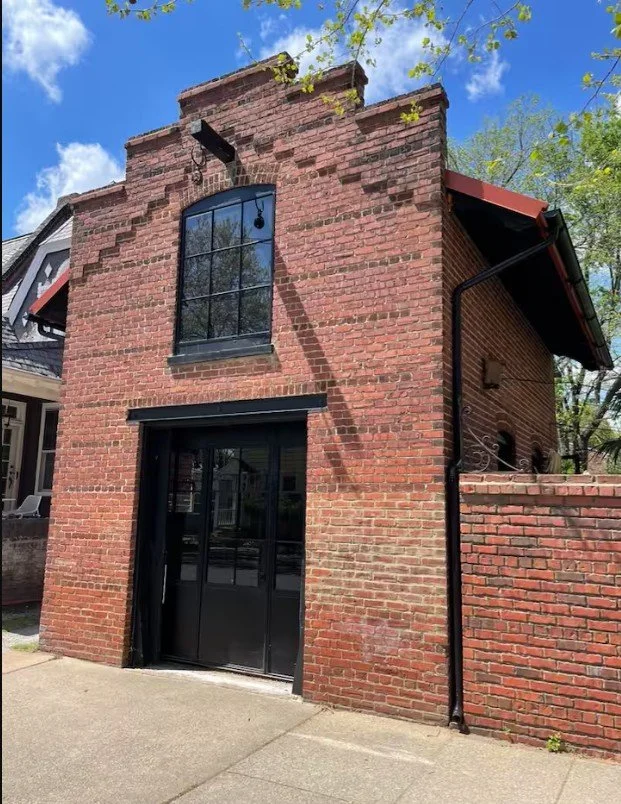
Accessory dwelling units (ADUs) are human-scale, backyard homes that expand housing choice, generate wealth and equity opportunities for local homeowners, and create vital affordable housing options within existing neighborhoods. Richmond has issued building permits for more than 115 ADUs since updating its local zoning rules to allow them citywide.
There are two ways this happens:
Filtering. Older homes get less expensive over time. Imagine a young person, just starting out, looking for their first place to live. What kind of housing are they likely to afford? For me, it was an apartment in a 100-year-old building. That’s filtering.
Moving chains. When a new apartment building opens, the people who move in leave their old homes behind, which frees up more affordable housing all over the city. One study found that for every 100 new market-rate homes, as many as 70 open up in lower-income areas. Another found that by the fourth move in the chain, a third of movers come from the bottom 20% of incomes.
This means more housing can slow the growth of housing costs and create more affordable options throughout the market.
But that raises another question: Does building new housing come at the expense of people who live nearby?
Again, research suggests new housing does not generally increase displacement — in many cases, it can reduce displacement pressures. Research found that:
New construction can reduce nearby displacement. One randomized study found that nearby rents and displacement risk both fell after new home construction — even tenants in nearby rent-controlled apartments were less likely to be evicted.
Both market-rate and income-restricted housing can ease displacement pressure. The Urban Displacement Project in San Francisco found that market-rate and income-restricted housing both eased displacement pressure, though subsidized housing worked about twice as well.
New housing can make neighborhoods more inclusive. Even in gentrifying areas, new market-rate construction didn’t significantly change how many residents moved out — but it did allow more people of all income levels to move in.
This data may feel completely contrary to the experience of many residents. When a new building goes up in your neighborhood and your rent increases soon after, the connection feels indisputable. But new construction most often happens in neighborhoods where demand is already increasing, so it’s easy to assume a new building is the cause of rising prices rather than a reaction to them. Researchers have grappled with whether a new building is the catalyst for or a symptom of rising costs and worked to separate these effects in their studies.
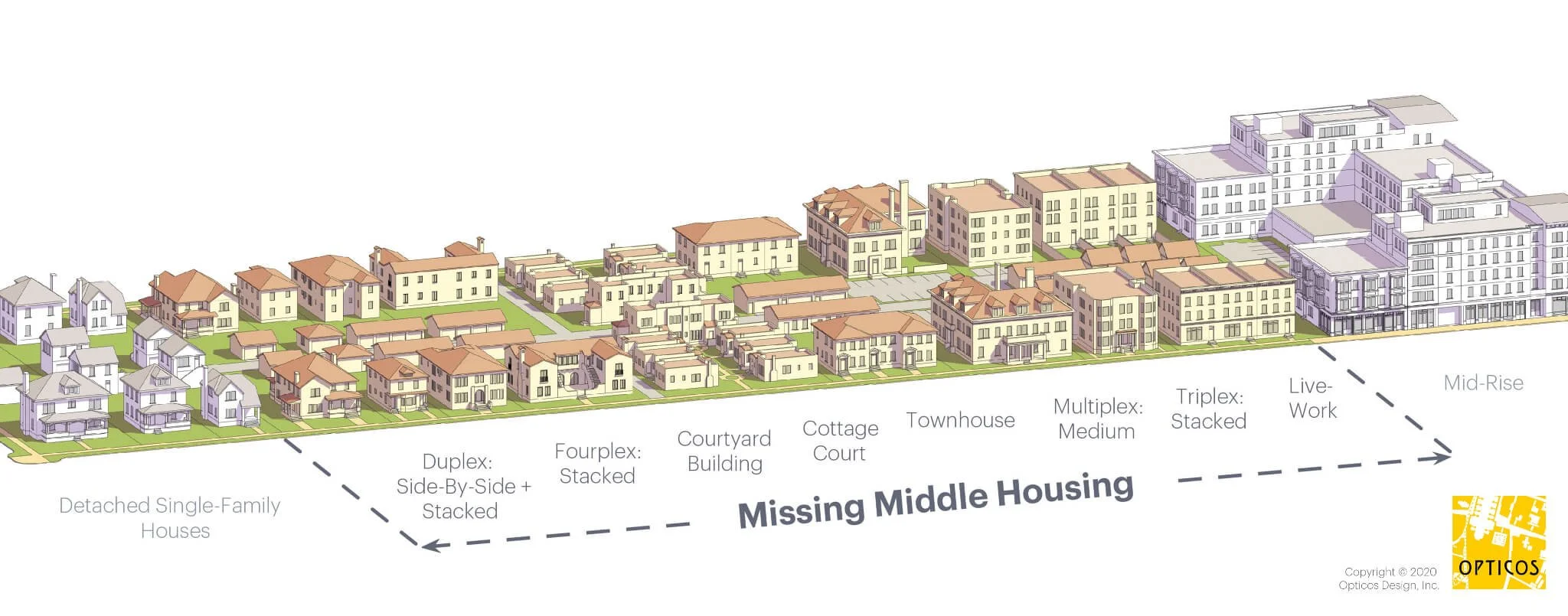
Missing middle housing includes a range of house-scale homes — such as duplexes, fourplexes, cottage courts, and multiplexes — that fit comfortably into existing neighborhoods. By offering more housing choices, these homes can help address today's housing shortage while supporting walkable communities, neighborhood businesses, and public transit. They also provide a wider range of housing options and price points to better meet the needs of people at different stages of life.
We must also acknowledge the limits of supply as a housing solution. While it’s clear that building housing is helpful overall, that doesn’t mean it will be equally helpful to everyone all of the time.
Higher-income residents are often the first and biggest beneficiaries of most new construction, while those with the lowest incomes still need housing subsidies. And there’s reason for caution: while most studies at the neighborhood block level found that new construction in low-income areas decreased nearby rents, there is evidence that rents could increase in some cases.
The takeaway? It’s important where we build, what we build, and who has access.
More homes make housing more affordable and available to people at different income levels, helping prevent displacement. But there are exceptions to every rule, and tools like rent stabilization and property tax relief are needed to help protect residents. We should also avoid concentrating opportunities for new housing in neighborhoods already experiencing displacement pressure. Stable communities that are less sensitive to cost increases should make room for more homes, too.
How Do We Zone to Prevent Displacement?
So what can Richmond learn from this? If a shortage of affordable housing is what puts Black and low-income residents most at risk, how do we zone to minimize displacement?
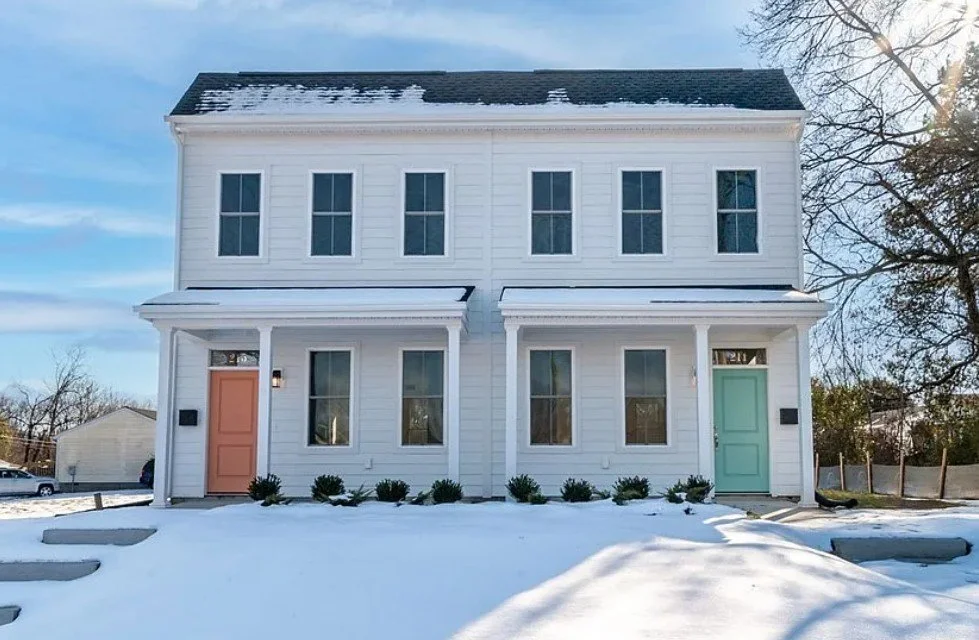
These townhomes were built in 2024 with a special use permit (SUP) on E Ladies Mile Road through the Maggie Walker Community Land Trust and were made available to purchasers who met specific income restrictions. This is one example of a multi-pronged approach to expanding affordable housing opportunities in Richmond.
Wealthy neighborhoods can’t sit this out. Areas like the 1st, 3rd, and 4th districts take up a lot of land and add comparatively little new housing. They cannot be exempted from changes that allow more kinds of homes.
An economic analysis of proposed changes in Code Refresh found that some changes could spur more housing in these areas, while others would not. Wide lot minimums make lot splits much less likely in affluent areas compared to low-income ones. Permitting duplexes, on the other hand, would result in almost no teardowns outside wealthy neighborhoods — 94% of workable lots sit in the 1st and 2nd districts.
To balance the scales, Draft 3 should allow duplexes in all residential zones, reduce the minimum lot width in the lowest-density neighborhoods, and allow taller buildings along transit corridors citywide. The city should also avoid targeted upzoning, or only rezoning small areas or particular parcels. This approach tends to increase land values without producing enough housing to help, as rezonings in Chicago and downtown Nashville have shown.
High-risk neighborhoods need extra care. These areas can benefit from zoning reform too, but the changes need fine-tuning. The city should use the displacement data already available and give residents of high-risk areas a voice in Code Refresh and what follows. Upzoning a marginalized neighborhood should come with real commitments to invest in infrastructure, services, and affordable housing.
Zoning alone isn’t enough. Preventing displacement takes much more than rewriting rules and building homes. We need to invest more in affordable housing. And the city needs a comprehensive strategy to stabilize low-income residents: stronger tenant protections, property tax relief, home repair programs, and preservation of the affordable housing we already have. Whatever happens with Code Refresh, at-risk residents deserve the extra support they need to stay.
Perhaps the greatest lesson is this: displacement becomes the inevitable companion of gentrification only when we don’t have enough housing.
That should give us hope. We can avoid repeating the harms of our past and build plentiful, diverse housing to meet the needs of every resident. But as in every city that has passed zoning reform, getting there will take an organized effort by residents who see that the benefits far outweigh the risks — and who understand the cost of doing nothing.